
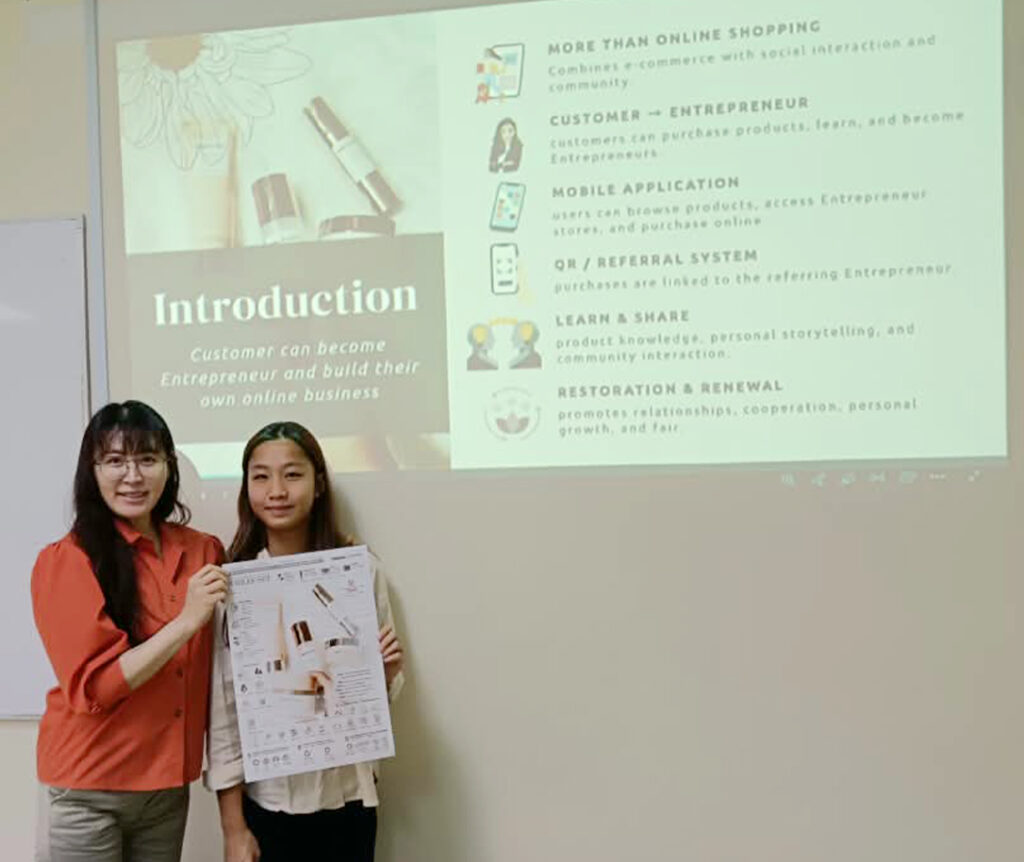
After a semester of exploring key e-commerce concepts, it was time for our Foundation in Science students to put into practice what they had learnt by creating their own e-commerce companies.
Armed with their knowledge on business models, value propositions, revenue models, target markets, marketing strategies, customer relationships, e-commerce features, business processes, and innovation in e-commerce, they were able to present the business models of different online businesses through posters.
One of the posters showcased a social commerce business model that combined online shopping, entrepreneurship, learning, and community engagement – illustrating elements such as customer and entrepreneur roles, product offerings, target customers, online shopping features, referral and commission functions, and the overall purchasing process.
The poster also demonstrated how students managed to incorporate current and future e-commerce ideas, including secure payments, order tracking, personal online stores, referral links, social engagement features, AI-based recommendations, AI customer service, and live shopping. This allowed them to connect the theories discussed in class with practical digital business applications.
Through their learning and project experience this semester, our students were able to strengthen their creativity, teamwork, communication, problem-solving, and presentation skills. More importantly, they learnt how to transform a business idea into a structured e-commerce model, identify suitable target customers, and design a customer journey, while communicating their ideas effectively through a professional visual presentation.
Nanthini Pattabiraman
Lecturer, School of Computing & Engineering


